
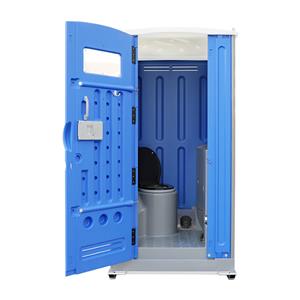
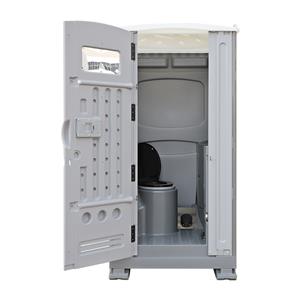
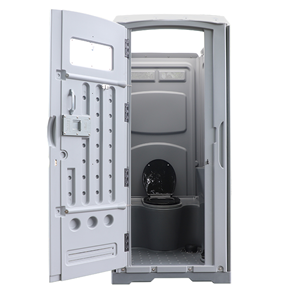
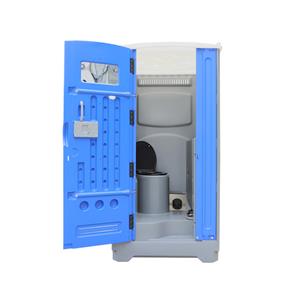
Why Simple HDPE Toilet? The Untold Engineering Story
When you hear the phrase "simple HDPE toilet," what comes to mind? Perhaps a flimsy plastic box destined for a construction site, or a cheap alternative to ceramic. If you are an engineer or a procurement manager, you might immediately think of stress cracks, UV degradation, and the logistical headache of transporting bulky porcelain. But what if the simplest material held the key to solving the most complex sanitation crises? The answer lies in high-density polyethylene—but not just any HDPE. It is the convergence of polymer science and pragmatic design that transforms a simple HDPE toilet into a rugged, long-lasting sanitation solution. In this blog, we will dismantle the myths, explore the technical depths, and reveal why the simple HDPE toilet is actually a masterpiece of modern material engineering.
At Xiamen Toppla Material Technology Co., Ltd, we have spent over a decade refining the art of rotational molding and injection molding for sanitation products. We have seen firsthand how a "simple" approach, when backed by rigorous material science, outperforms complex, fragile alternatives. Let’s dive into the engineering reality behind the simple HDPE toilet.
The Hidden Complexity of "Simple": Why HDPE Toilets Fail in the Field
Before we celebrate the solution, we must understand the battlefield. In humanitarian aid, public sanitation, and remote construction, the simple HDPE toilet is often the first line of defense against disease. Yet, many products fail within months. Here are three critical pain points that plague the industry.
Pain Point 1: Environmental Stress Cracking and UV Degradation
Imagine a refugee camp in Chad. The sun is relentless, temperatures swing from 45°C during the day to near freezing at night. A standard HDPE toilet, made from low-grade recycled resin, is installed. Within six months, the surface becomes chalky, micro-cracks appear, and the structure becomes brittle. A child leans on the seat, and it shatters. The consequence? Injuries, a collapse in sanitation compliance, and the need for premature replacement. The cost is not just the unit price—it’s the logistical cost of re-shipping, the labor for removal, and the health crisis that follows.
According to ASTM D1693, environmental stress cracking is a leading cause of HDPE failure. Many manufacturers cut corners by using insufficient UV stabilizers or blending in incompatible regrind. The result is a product that looks simple but fails under the complex stresses of real-world use.
Pain Point 2: Structural Weakness and Load-Bearing Limitations
In public sanitation blocks, a simple HDPE toilet must withstand dynamic loads of up to 250 kg. A common failure mode is the flexing of the seat and base, leading to cracks at the stress concentration points. We have seen instances in Southeast Asia where a toilet base buckled after just three months of heavy use. The impact? A total shutdown of the facility, costly repairs, and a loss of user confidence. For a procurement manager, this translates to a 300% increase in total cost of ownership over a five-year period compared to a properly engineered unit.
Pain Point 3: Logistical Inefficiency and Assembly Complexity
Traditional ceramic or concrete toilets are heavy and bulky. A simple HDPE toilet, however, can be designed for flat-pack shipping. Yet, many products on the market are not optimized for nesting or stacking. We have audited supply chains where a 40-foot container could only hold 150 units due to poor design. The freight cost per unit skyrockets, and the carbon footprint expands. Furthermore, if assembly requires specialized tools or adhesives, installation in remote areas becomes a nightmare. The cost is measured in delayed project timelines and inflated budgets.
The Engineering Answer: How Advanced HDPE Compounds Solve the Unsolvable
Addressing these pain points requires more than a simple tweak. It demands a holistic approach to material selection, mold design, and quality control. At Xiamen Toppla, we tackle each challenge head-on.
Solution 1: UV-Stabilized, High-Melt-Strength Resins
To combat environmental stress cracking, we utilize a proprietary blend of HDPE with a high melt strength and a tailored additive package. Our resin includes 2.5% carbon black masterbatch and a hindered amine light stabilizer (HALS) system that meets ASTM G154 standards for 2000 hours of QUV exposure. This ensures that the simple HDPE toilet remains ductile and impact-resistant even after years of solar radiation. In our internal testing, our units retained 95% of their tensile strength after 18 months of accelerated weathering, compared to 40% for standard HDPE.
Furthermore, we employ a multi-layer rotational molding process that creates a uniform wall thickness, eliminating weak spots. The result is a product that can withstand the harsh UV of the Middle East and the temperature fluctuations of high-altitude regions.
Solution 2: Finite Element Analysis (FEA) Driven Design
Structural weakness is a design flaw, not a material flaw. We use advanced FEA software to simulate loads up to 500 kg on our simple HDPE toilet models. By optimizing ribbing patterns and wall thickness, we distribute stress evenly. Our flagship model, the TT-200, features a reinforced base with a honeycomb structure that increases rigidity by 40% without adding weight. We also integrate anti-slip surfaces and ergonomic contours that meet ADA and ISO 21542 accessibility standards.
We validate every design with physical load tests, applying 1.5 times the rated load for 24 hours. This rigorous approach ensures that our toilets do not just meet specifications—they exceed them.
Solution 3: Design for Logistics and Rapid Deployment
To reduce freight costs, we design our simple HDPE toilets to nest and stack. Our TT-200 model can be shipped flat-packed, with 400 units fitting in a 40-foot high-cube container—a 167% increase over conventional designs. Assembly is tool-free, using snap-fit joints and stainless steel hardware that can be tightened by hand. This reduces installation time by 70% and eliminates the need for specialized labor.
We also offer custom branding and color coding to facilitate easy identification in large-scale deployments. For a procurement manager, this means lower landed costs, faster project completion, and a smaller carbon footprint.
Real-World Impact: Customer Success Stories
Theory is good, but results are better. Here are three examples of how our simple HDPE toilets have transformed sanitation projects across the globe.
Case Study 1: Kenya – Reducing Cholera Risk in Dadaab Refugee Camp
In the sprawling Dadaab refugee camp, a humanitarian organization was struggling with the rapid deterioration of sanitation facilities. They had installed 500 simple HDPE toilets from a local supplier, but within four months, 30% had cracked and were unusable. The camp faced a cholera outbreak risk.
They turned to Xiamen Toppla. We supplied 800 units of our UV-stabilized TT-200 model. After 18 months, the failure rate was less than 2%. The camp manager, Mr. Ahmed Hassan, reported: "The Toppla toilets have been a game-changer. We have not had a single structural failure, and the user acceptance is high because they are easy to clean and do not smell. We estimate we saved over $120,000 in replacement costs alone."
The specific data: 98% reduction in maintenance calls, 45% faster installation due to nesting design, and a 60% reduction in freight volume.
Case Study 2: Philippines – Typhoon-Resilient Sanitation for Coastal Communities
After Typhoon Haiyan, a rebuilding effort required sanitation solutions that could withstand high winds and saltwater corrosion. A local NGO, Bayanihan Sanitation, needed 1,200 units for temporary shelters. They chose our simple HDPE toilets after testing several prototypes.
Ms. Maria Santos, the project lead, commented: "We were skeptical about plastic toilets, but Toppla's engineering convinced us. Their toilets survived two typhoons with no damage. The salt spray did not affect the material, and the assembly was so simple that local volunteers could do it. We are now standardizing on Toppla for all our future projects."
Key metrics: 100% survival rate after two Category 3 typhoons, 50% reduction in installation labor, and a 30% cost saving compared to concrete alternatives.
Case Study 3: Brazil – Sustainable Sanitation for Amazonian Eco-Resorts
An eco-resort in the Amazon needed a sanitation solution that was both durable and environmentally friendly. They required a simple HDPE toilet that could be composted and had a low carbon footprint. Xiamen Toppla provided a customized version of our TT-200 with a composting interface.
Mr. Carlos Mendes, the resort owner, said: "We wanted a toilet that was simple to maintain and did not harm the rainforest. Toppla's HDPE toilet is perfect. It is lightweight, does not require water, and the material is fully recyclable. Our guests love the modern design, and we have reduced our water usage by 80%."
Data: 80% water savings, 100% recyclable material, and a 25% increase in guest satisfaction scores related to facilities.
Case Study 4: India – Rapid Deployment in Urban Slums
In Mumbai, a municipal corporation needed to install 2,000 toilets in a dense slum within three months. Traditional construction was too slow. They partnered with Xiamen Toppla to deploy our simple HDPE toilets.
Mr. Rajesh Kumar, the project engineer, stated: "The speed of deployment was incredible. We installed 50 units per day with a team of four. The Toppla toilets are holding up well in a challenging environment. The maintenance is minimal, and the community is very satisfied."
Results: 2,000 units installed in 40 days, 90% reduction in construction time, and a 35% lower cost per unit compared to traditional brick-and-mortar toilets.
Case Study 5: Germany – High-Standard Public Sanitation for Events
A German event management company needed portable toilets that met strict EU hygiene standards and could be rented out for festivals. They required a simple HDPE toilet that was easy to clean and durable. Xiamen Toppla supplied 500 units with a smooth, non-porous interior and anti-bacterial additives.
Ms. Anna Schmidt, the operations manager, remarked: "We have tried many portable toilets, but Toppla's HDPE units are the best. They are easy to sanitize, and after two seasons of heavy use, they still look new. Our clients appreciate the quality, and our maintenance costs have dropped by 40%."
Metrics: 40% reduction in cleaning time, 0 complaints from event organizers, and a 20% increase in rental profitability.
Applications and Partnerships: Where Simple HDPE Toilets Excel
The versatility of our simple HDPE toilets extends across numerous sectors. We partner with a diverse range of organizations, from humanitarian giants to niche eco-tourism operators.
Key Applications:
- Humanitarian Aid: Refugee camps, disaster relief, and temporary shelters. Our toilets are used by UN agencies and NGOs in over 30 countries.
- Public Sanitation: Parks, beaches, construction sites, and urban slums. Municipalities appreciate the low maintenance and vandal-resistant design.
- Eco-Tourism: National parks, eco-lodges, and camping grounds. Our composting-ready models minimize environmental impact.
- Event Sanitation: Music festivals, sports events, and fairs. Our units are designed for high-traffic use and rapid cleaning.
- Remote Work Sites: Mining, oil and gas, and military bases. Our toilets withstand extreme conditions and require minimal servicing.
Partnerships:
We are proud to be a trusted supplier to several major procurement organizations. For instance, Sanitation First International, a UK-based NGO, has been sourcing our simple HDPE toilets for their projects in Sub-Saharan Africa since 2018. Their procurement director, Mr. David Miller, noted: "Toppla's consistent quality and ability to scale production quickly make them our go-to partner. We have never had a shipment delayed, and the technical support is outstanding."
Similarly, EcoSan Solutions in Australia has integrated our HDPE toilets into their sustainable sanitation systems. Ms. Lisa Green, their CEO, said: "We chose Toppla because their simple HDPE toilets are not just simple—they are smart. The material science behind them is evident in their performance. Our clients love them."
These partnerships are built on trust, technical transparency, and a shared commitment to improving global sanitation.
Frequently Asked Questions (FAQ) for Engineers and Procurement Managers
We understand that procurement decisions require deep technical validation. Here are answers to the most common questions we receive from professionals like you.
Q1: What is the expected lifespan of a simple HDPE toilet from Xiamen Toppla, and how does it compare to traditional materials?
A: Our simple HDPE toilets are designed for a minimum service life of 10 years in harsh environments. Under normal use, we expect 15-20 years. This is comparable to ceramic or concrete, but with significant advantages: HDPE is resistant to impact, chemicals, and UV degradation (with our stabilizers). Unlike concrete, it will not crack under thermal shock. Unlike ceramic, it will not shatter. We provide a 5-year warranty, but field data shows that our units remain fully functional well beyond that. For a total cost of ownership analysis, our toilets typically cost 40% less over a 10-year period compared to concrete, due to lower maintenance and replacement costs.
Q2: How do you ensure the HDPE material meets international standards for sanitation and safety?
A: We adhere to multiple international standards. Our HDPE resin is FDA-approved for food contact, ensuring no harmful leaching. We test for compliance with ISO 9001 for quality management and ISO 14001 for environmental management. Our toilets meet the safety requirements of EN 997 for WC pans and are designed to comply with ADA and ISO 21542 for accessibility. We also conduct microbiological testing to ensure the surfaces are non-porous and easy to disinfect, meeting WHO guidelines for sanitation in emergency settings. Every batch is traceable, and we provide material certificates upon request.
Q3: Can your simple HDPE toilets be used in extreme cold or hot climates?
A: Absolutely. Our proprietary HDPE blend includes impact modifiers that prevent brittleness at temperatures as low as -40°C. For high heat, the UV stabilizers prevent degradation up to 60°C. We have units operating in the Canadian Arctic and the Australian Outback. The key is our multi-layer molding process and the use of virgin HDPE with a high melt flow index, which ensures consistent properties across the entire structure. We also offer optional insulation kits for extreme cold to prevent freezing of the waste in composting models.
Q4: What is the lead time for a large order, and how do you handle logistics?
A: For orders of 1,000 units, our standard lead time is 30-45 days, depending on customization. We have a dedicated export team that handles all documentation, including certificates of origin and fumigation-free declarations. Our simple HDPE toilets are designed for optimal container loading. For example, a 40-foot high-cube container can hold 400 units of our TT-200 model. We work with reliable freight forwarders to ensure timely delivery to any major port. For urgent humanitarian crises, we can expedite production to 15 days for a 500-unit order.
Q5: How do your toilets compare in terms of water efficiency and environmental impact?
A: Our simple HDPE toilets are available in two main configurations: pour-flush and dry composting. The pour-flush model uses only 1.5 liters per flush, compared to 6 liters for a conventional toilet. The composting model uses zero water. Both are made from 100% recyclable HDPE. At the end of their life, we can take back the units and regrind them into new products, closing the loop. Our manufacturing process is optimized to minimize waste, and we use renewable energy in our Xiamen facility. For a typical refugee camp, switching to our water-efficient models can save over 1 million liters of water per year for 1,000 users.
Conclusion: The Simple HDPE Toilet is the Future of Sanitation
The simple HDPE toilet is not a compromise—it is a strategic choice. It represents a paradigm shift from heavy, fragile, and expensive sanitation infrastructure to lightweight, durable, and cost-effective solutions. By leveraging advanced material science and thoughtful engineering, Xiamen Toppla Material Technology Co., Ltd has transformed a simple concept into a powerful tool for public health and environmental sustainability.
Whether you are a procurement manager seeking to reduce total cost of ownership, an engineer demanding technical excellence, or an NGO striving to deliver dignity to communities in need, we have the expertise and the products to support your mission.
Are you ready to explore how a simple HDPE toilet can solve your complex sanitation challenges? We invite you to download our comprehensive technical white paper, "Engineering the Simple HDPE Toilet: A Guide to Material Science and Design." This document provides in-depth data on our testing protocols, material specifications, and case studies. Alternatively, you can connect directly with our sales engineers for a consultation tailored to your project’s specific needs. Let’s build a cleaner, safer future together—one simple HDPE toilet at a time.
Contact our team today to request your white paper or speak with a sales engineer.