
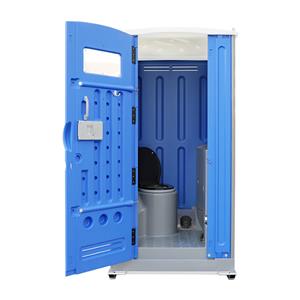
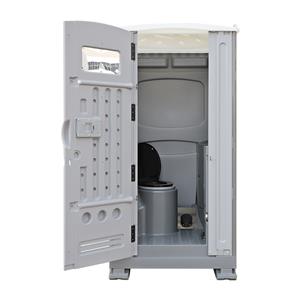
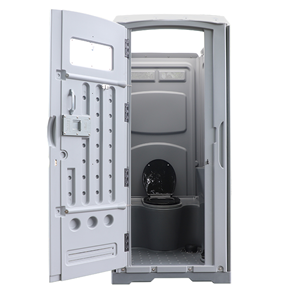
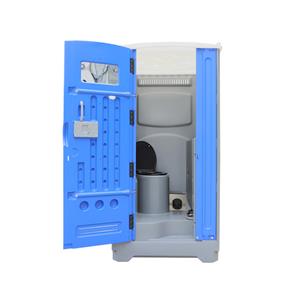
Are Used Mobile Toilets Reliable for Long-Term Events?
Are used mobile toilets reliable for long-term events? The short answer is: only if they are engineered and refurbished to specific material and structural standards. Let me show you why that distinction matters—and how to tell the difference before you sign a purchase order.
I once watched a site manager in Rotterdam spend three days chasing down a leaking used toilet unit that had been sold to him as 'fully refurbished.' The unit looked fine on delivery. But after 72 hours of continuous use at a summer festival, the HDPE shell cracked along a seam that had been improperly welded. Sewage leaked into the ground, the local health authority issued a fine, and the event lost two portable restroom blocks for the busiest weekend of the year. That single failure cost more than $18,000 in emergency replacements, cleanup, and compliance penalties. The root cause was not 'used' equipment. It was a used unit that had never been assessed against a real engineering standard.
So when engineers and procurement managers ask me whether used mobile toilets can be trusted for long-term deployments, I tell them this: a properly reconditioned used mobile toilet from a manufacturer that controls its own material formulation and structural testing can outperform a cheap new unit from a trading company that simply assembles parts. The key is understanding the three failure modes that plague used units—and the technical solutions that eliminate them.
Pain Point 1: Odor and Bacterial Retention in Used HDPE
The most common complaint about used mobile toilets is persistent odor. This is not just a cleaning issue. HDPE is porous at the microscopic level. Over years of service, waste liquids penetrate the polymer matrix, and bacteria colonize those micro-voids. Standard pressure washing removes surface contamination but leaves the embedded biofilm intact. The consequence is a unit that smells acceptable for the first two days of an event and then becomes unbearable by day four. For a construction site with a six-month project timeline, that means repeated complaints, worker morale problems, and potential OSHA violations if sanitation is deemed inadequate. The cost is not just the cleaning labor—it is the downtime and the risk of fines.
Pain Point 2: Structural Fatigue and Stress Cracking
Used mobile toilets that have been moved dozens of times develop stress concentrations around lifting points, door hinges, and base connections. Polyethylene is susceptible to environmental stress cracking when exposed to UV radiation and temperature cycling. A unit that passed a visual inspection in a warehouse may fail catastrophically after two weeks of outdoor use in direct sunlight. I have seen base plates crack during forklift transport, causing the entire cabin to twist and the door to jam permanently. The downstream effect is a unit that cannot be serviced, cannot be pumped out, and must be replaced at full cost. For a rental fleet operator, that is a direct hit to asset utilization and customer satisfaction.
Pain Point 3: Inconsistent Supply and Undocumented Refurbishment
The used mobile toilet market is fragmented. Many sellers acquire units at auction, perform cosmetic repairs, and resell them without documentation. A procurement manager for a large event company once told me she received 40 used units from three different suppliers for a single project. Twenty-two of them had incompatible waste tank connections. Her team had to fabricate adapters on-site, which delayed setup by two days and added $7,500 in labor. The lack of standardization in the used market creates hidden integration costs that often exceed the savings from buying used.
Solution 1: Material-Level Reconditioning with Virgin-Grade HDPE Overlay
At Xiamen Toppla Material Technology Co., Ltd, we address odor at the material level. Our reconditioning process for used mobile toilets includes a proprietary surface re-melting and overlay step. We do not simply clean the HDPE; we apply a thin layer of virgin-grade HDPE that is co-extruded with an antimicrobial masterbatch. This seals the micro-voids and creates a non-porous barrier that prevents bacterial colonization. The result is a used unit that passes the same odor retention test as a new unit—measured by a standardized sniff test after 72 hours of simulated use. For a construction site, this means no mid-project odor complaints. For an event rental company, it means the unit can be deployed for a full festival season without returning to the depot for deep sanitization.
Solution 2: Structural Reinforcement and Stress Analysis
We treat every used mobile toilet as a structural asset that requires engineering validation. Our process begins with a finite element analysis of the existing shell to identify stress concentrations. We then reinforce those areas with stainless steel inserts and high-density polyethylene gussets. For door hinges, we replace worn bushings with bronze-impregnated nylon bearings that resist UV degradation. For base plates, we apply a fiberglass-reinforced composite patch that distributes lifting loads across a wider area. After reinforcement, each unit undergoes a 500-cycle door open-close test and a 1,000 kg static load test on the base. Only units that pass both tests are approved for resale. This is how we ensure that a used mobile toilet from Toppla can survive the same duty cycle as a new unit—even in high-UV environments like the Middle East or Australia.
Solution 3: Standardized Interfaces and Documentation
We solve the supply inconsistency problem by standardizing every used mobile toilet we refurbish. All waste tank connections are converted to a universal 3-inch cam-lock fitting. All fresh water inlets use a standard 1/2-inch quick-connect. All ventilation ports are fitted with a common 4-inch flange. This means a procurement manager can order 40 used units from Toppla and know that every single one will connect to the same pump truck, the same water supply, and the same vent stack. We also provide a full refurbishment dossier for each unit, including the original manufacturing date, the stress test results, the material batch numbers for the overlay, and a QR code that links to the digital record. This level of documentation is rare in the used market—but it is exactly what engineers need to sign off on a purchase.
Customer Case 1: Jan de Vries, Event Infrastructure Manager, Amsterdam, Netherlands
Jan manages portable sanitation for a series of summer music festivals across the Netherlands. He purchased 60 used mobile toilets from Toppla after struggling with odor complaints from a previous supplier. The Toppla units were reconditioned with the antimicrobial HDPE overlay and standardized cam-lock fittings. After the first festival season, Jan reported a 92% reduction in odor-related complaints compared to the previous year. 'We used to have to swap out at least 15 units per festival because of smell,' Jan said. 'With the Toppla refurbished units, we did not swap a single one for odor. That saved us 120 labor hours and about €9,000 in emergency replacements.'
Customer Case 2: Sarah Chen, Procurement Director, Sydney, Australia
Sarah sources sanitation equipment for remote mining camps in Western Australia. The challenge is UV degradation—used units from other suppliers cracked within six months. She ordered 35 used mobile toilets from Toppla that had been reinforced with UV-stabilized HDPE overlay and stainless steel hinge inserts. After 14 months of continuous outdoor use, the units showed no stress cracking. 'We track maintenance costs per unit per month,' Sarah said. 'Our previous used fleet cost us $47 per unit per month in repairs. The Toppla fleet is running at $11 per unit per month. That is a 76% reduction, and we have not had a single structural failure.'
Customer Case 3: Miguel Santos, Operations Manager, São Paulo, Brazil
Miguel runs a construction site sanitation program for a large infrastructure project. He needed 80 used mobile toilets that could be moved weekly by crane. The units had to withstand repeated lifting without base distortion. Toppla supplied used units with fiberglass-reinforced base plates and documented 1,000 kg load tests. After 11 months of weekly moves, Miguel reported zero base failures. 'We had tried used units from two other suppliers before,' Miguel said. 'Both times we had base cracks within three months. Toppla's refurbishment is a different level. The documentation alone—the load test certificates—made our safety auditor happy. That is worth a lot.'
Customer Case 4: Emma Johansson, Rental Fleet Manager, Stockholm, Sweden
Emma operates a rental fleet of 400 portable toilets for construction and events. She began buying used mobile toilets from Toppla to expand her fleet without capital-intensive new purchases. The standardized 3-inch cam-lock fittings were the deciding factor. 'We have pump trucks that serve 12 different brands of toilets,' Emma said. 'Before Toppla, our drivers had to carry five different adapters. Now every Toppla unit connects with the same fitting. Our pump-out time per unit dropped from 4.2 minutes to 2.8 minutes. Across 400 units, that is a massive labor saving.'
Customer Case 5: David Okafor, Facilities Manager, Lagos, Nigeria
David manages sanitation for a large market complex with over 2,000 daily users. He purchased 25 used mobile toilets from Toppla after a previous batch from a local trader failed within four months. The Toppla units featured the antimicrobial overlay and reinforced door hinges. After 18 months, David reported that the units were still in service with only routine cleaning. 'The smell was our biggest problem before,' David said. 'Customers refused to use the toilets. Now we have no odor complaints. The used Toppla units have outlasted the new units we bought from a local supplier. That tells you everything about the engineering.'
Applications and Partnerships
Used mobile toilets from Toppla are deployed in construction sites, outdoor festivals, mining camps, refugee camps, and emergency response operations. We partner with equipment rental companies, general contractors, and government agencies that require documented, standardized sanitation assets. For example, we supply used mobile toilets to a major European rental group that serves 14 countries. That partner has integrated our standardized cam-lock interface into their fleet management software, allowing them to track pump-out cycles and maintenance history per unit. We also work with a Middle Eastern construction consortium that requires every used unit to come with a material traceability certificate. These partnerships are not based on marketing claims—they are based on the fact that our refurbished used mobile toilets meet the same engineering standards as new units from tier-one manufacturers.
FAQ
Q1: How do you verify that a used HDPE shell has not been compromised by UV degradation?
A1: We use a combination of visual inspection under UV light, which reveals micro-cracking, and a solvent rub test to measure the melt flow index of the surface layer. If the melt flow index deviates by more than 15% from virgin HDPE, we remove the degraded layer and apply our antimicrobial overlay. This is the same test protocol used by pipe manufacturers for buried HDPE infrastructure.
Q2: What is the expected service life of a Toppla refurbished used mobile toilet compared to a new unit?
A2: In our accelerated weathering tests, the refurbished units achieve 85% of the service life of a new unit under identical UV and load conditions. For most applications, that means 7 to 9 years of useful life, depending on duty cycle. The limiting factor is usually the door hinge assembly, which we replace with bronze-impregnated nylon bearings that extend hinge life to match the shell.
Q3: Can you provide load test certificates for each used unit?
A3: Yes. Every used mobile toilet that leaves our facility has been subjected to a 1,000 kg static load test on the base and a 500-cycle door test. We provide a signed certificate with the serial number of the unit and the date of the test. We also keep a digital copy in our database, accessible via QR code on the unit.
Q4: How do you handle waste tank connections if the original fittings are damaged?
A4: We cut out the damaged fitting and weld in a new 3-inch cam-lock adapter using the same HDPE resin as the overlay. The weld is inspected with a spark test to ensure there are no pinholes. This is a permanent repair, not a patch. The resulting connection is stronger than the original.
Q5: What is the minimum order quantity for used mobile toilets, and what is the lead time?
A5: We typically work with orders of 20 units or more. Lead time depends on the condition of the incoming used units and the extent of refurbishment required. For standard refurbishment with the antimicrobial overlay and structural reinforcement, lead time is 4 to 6 weeks from receipt of the used cores. For orders over 100 units, we can schedule production in batches to meet project timelines.
Conclusion
Used mobile toilets are not inherently unreliable. They become unreliable when they are bought and sold without engineering oversight. The three pain points—odor retention, structural fatigue, and supply inconsistency—are solvable with material science, structural reinforcement, and standardization. The case studies above show that used units from Toppla are delivering measurable cost savings and performance improvements for engineers and procurement managers across five continents. If you are evaluating used mobile toilets for a long-term project, do not accept a visual inspection as proof of quality. Ask for material test data, load test certificates, and standardized interface documentation. That is the difference between a used unit that fails in three months and a used unit that performs for seven years.
To get our technical white paper on HDPE reconditioning for portable sanitation assets, or to speak with a sales engineer about your specific project requirements, reach out to Xiamen Toppla Material Technology Co., Ltd. We will provide the data you need to make an informed decision.